
The Battle of Gettysburg: Three Days That Changed the Civil War


For three days in July 1863, Union and Confederate forces fought one of the largest battles of the American Civil War. The Battle of Gettysburg brought tens of thousands of soldiers to a small Pennsylvania town and produced devastating losses on both sides.
The battle ended Confederate General Robert E. Lee's second invasion of the North and became a major turning point in the war. From the opening clashes on July 1 to the failure of Pickett's Charge on July 3, Gettysburg showed the enormous human cost of the conflict.
Lee Takes the War North
By the summer of 1863, Lee and his Army of Northern Virginia had achieved several important victories. He moved north into Pennsylvania hoping to gather supplies, relieve pressure on Virginia, and possibly weaken Northern support for the war.
Union forces followed under Major General George G. Meade, who had taken command of the Army of the Potomac only days earlier. Neither army planned to fight at Gettysburg, but their movements brought them toward the same crossroads town.

The Battle Begins
Fighting began on July 1, 1863, when Confederate and Union forces encountered each other near Gettysburg. As reinforcements arrived, a smaller clash quickly became a major battle involving thousands of soldiers.
Confederate troops pushed Union forces through the town, but the Union army regrouped on strong defensive ground to the south. Positions such as Cemetery Hill and Culp's Hill gave Meade's army an advantage during the next two days.

A Fierce Second Day
On July 2, Lee ordered attacks against both ends of the Union line. Fierce fighting erupted at Little Round Top, the Wheatfield, the Peach Orchard, Cemetery Hill, and Culp's Hill.
Union troops held most of their key positions despite repeated Confederate assaults. By nightfall, the defensive line remained intact, but both armies had suffered heavy casualties and Lee prepared for another attack.
Pickett's Charge
On July 3, Confederate artillery bombarded the Union center before Lee ordered approximately 12,500 soldiers to advance across open ground toward Cemetery Ridge. The assault became known as Pickett's Charge, although troops from several Confederate divisions took part.
Union artillery and rifle fire struck the advancing soldiers as they crossed the field. Some reached the Union line, but the attack failed and Confederate forces suffered severe losses. Lee's army could no longer continue the offensive.
The Aftermath of Gettysburg
Lee began withdrawing toward Virginia on July 4. The three-day battle produced roughly 51,000 casualties, including soldiers who were killed, wounded, captured, or missing, making Gettysburg one of the bloodiest battles of the Civil War.
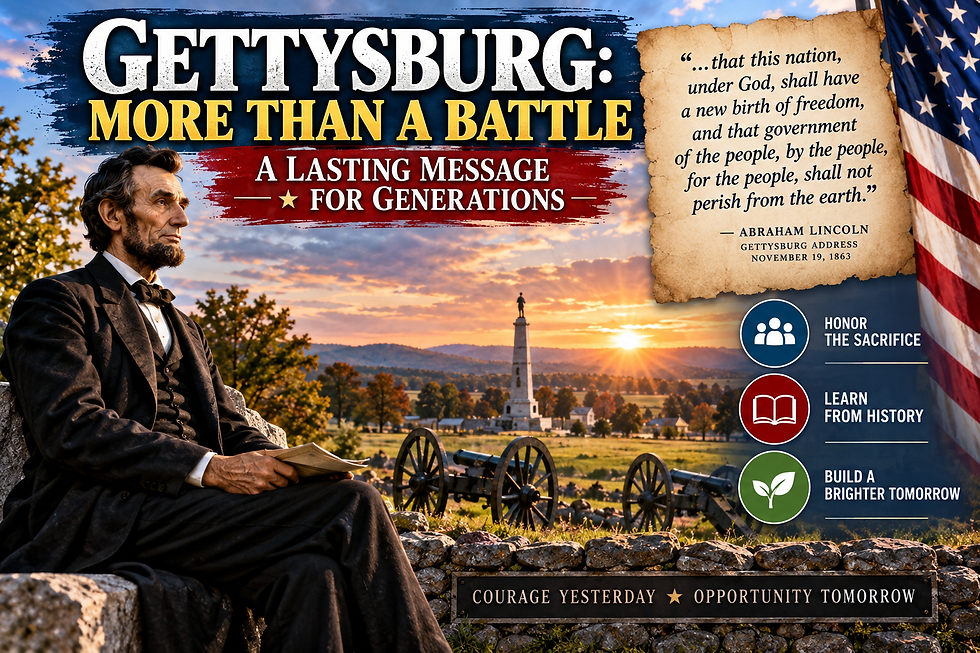
The Union victory stopped Lee's invasion of the North and strengthened Northern morale. Months later, President Abraham Lincoln visited Gettysburg to dedicate a national cemetery and delivered the Gettysburg Address, connecting the soldiers' sacrifice to the nation's founding principles and the struggle for freedom.
Final Thoughts
Gettysburg did not end the Civil War, but it changed the direction of the conflict. Lee never again launched an invasion of the North on the same scale, while Union armies continued increasing pressure on the Confederacy.
The fields around Gettysburg became a lasting reminder of the war's enormous cost. Three days of fighting shaped the course of the conflict and secured Gettysburg's place as one of the defining battles in American history.
Comments