
The California Gold Rush: How Gold Transformed the West


A small piece of gold discovered in California in 1848 helped trigger one of the greatest migrations in American history.
Within a few years, people from across the United States and around the world poured into California hoping to make their fortunes. Mining camps became towns, San Francisco became a booming city, and new transportation and trade networks connected the West to the rest of the country.
But the California Gold Rush also brought displacement, environmental damage, and enormous hardship, especially for Native communities.
Gold Is Discovered at Sutter's Mill
On January 24, 1848, James W. Marshall discovered gold while working on a sawmill for John Sutter along the South Fork of the American River near Coloma.
Marshall and Sutter initially tried to keep the discovery quiet. The news soon spread.
President James K. Polk confirmed the discovery in a message to Congress in December 1848. By the following spring, thousands of people were preparing to travel west.
The rush was on.

The Forty-Niners Head West
Gold seekers who arrived during 1849 became famously known as the Forty-Niners.
Some traveled thousands of miles overland in wagon trains. Others sailed around Cape Horn or traveled to Panama, crossed the isthmus, and continued north by ship.
The journey could be expensive and dangerous. Travelers faced disease, scarce water, difficult terrain, and months away from home.
Still, the possibility of finding gold attracted people from across the world.

California Changes Almost Overnight
The sudden migration transformed California.
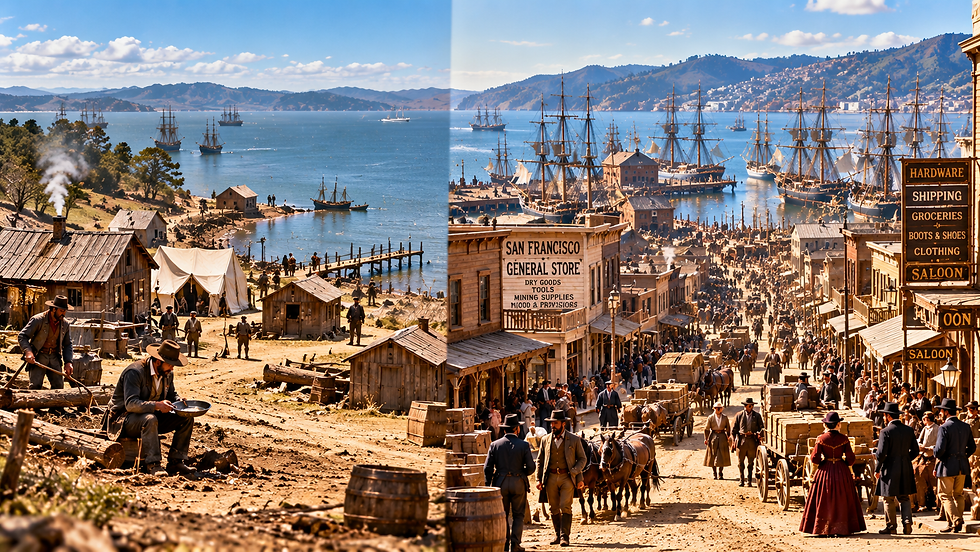
San Francisco had fewer than 1,000 residents shortly before the Gold Rush. By 1849, its population had surged to roughly 25,000 as miners, merchants, sailors, laborers, and entrepreneurs arrived.
Businesses appeared to serve the growing population. Hotels, stores, restaurants, transportation companies, and suppliers could sometimes offer more dependable opportunities than mining itself.
California's population growth also accelerated its political development. In 1850, California entered the Union as the 31st state.
The Rush Had a Human Cost
The Gold Rush created opportunity for some, but its consequences were devastating for many Native Californians.
Newcomers competed for land, food, water, and other resources that Native communities had depended on for generations. Mining and settlement damaged landscapes and waterways, while disease, displacement, and violence devastated Indigenous populations.
Immigrant miners also encountered discrimination.
People came from Mexico, China, Europe, South America, Australia, and elsewhere. California became increasingly diverse, but racial prejudice and discriminatory laws shaped who could participate freely in the new economy.
Gold Transforms the American West
The Gold Rush changed far more than California's mining districts.
It increased migration across western trails, expanded Pacific trade, stimulated businesses, and strengthened connections between California and the rest of the United States.
Gold also helped finance California's rapid economic development.
Yet relatively few miners achieved the extraordinary wealth they had imagined. For many, the real transformation came from the communities, industries, and infrastructure that grew around the search for gold.
The California Gold Rush turned a discovery in a mill's water channel into an international event.
Its legacy can still be seen in California's cities, cultural diversity, economy, and landscape. It helped accelerate the development of the American West, while leaving consequences that were far more complicated than the promise of striking it rich.
Comments