
The Constitutional Convention: How America Designed a New Government


In the summer of 1787, delegates gathered in Philadelphia to solve a serious problem. The United States had won independence, but its first system of government was struggling. The Constitutional Convention began as an effort to repair that system. Instead, the delegates created an entirely new framework that would shape the federal government for generations.
The result was the U.S. Constitution, but reaching an agreement required months of debate and difficult compromises.
Why the Articles of Confederation were not working
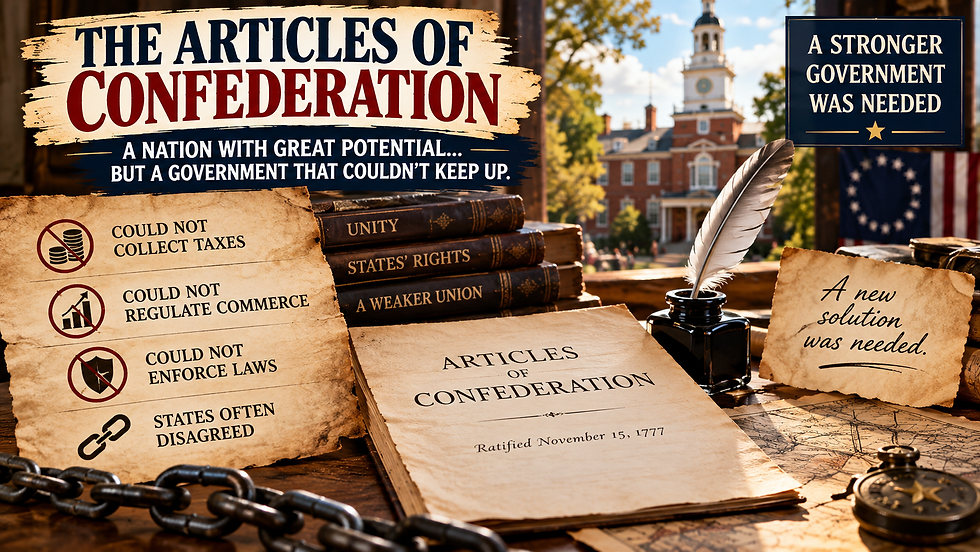
America's first national framework, the Articles of Confederation, intentionally created a weak central government. Congress could make decisions and request money from the states, but it lacked important powers. It could not effectively collect taxes or regulate interstate and foreign commerce, and disagreements among the states created additional problems.
Delegates therefore assembled in Philadelphia in May 1787. Their official purpose was to revise the Articles. By mid-June, however, they had decided that revision was not enough. They began designing a new national government instead.
The debate over representation
One of the convention's biggest disagreements concerned representation in Congress. Large states generally supported representation based on population, while smaller states feared that this arrangement would leave them with little influence.
The solution became known as the Great Compromise, or Connecticut Compromise. The new Congress would have two chambers. Representation in the House of Representatives would be based on population, while every state would receive equal representation in the Senate. The convention narrowly approved this arrangement on July 16, 1787.
This structure balanced two different principles: representation of the population and representation of the states.

Building a government with divided powers
The delegates also had to determine how much authority the national government should possess. The system they designed divided federal power among legislative, executive, and judicial branches.
Congress would make federal laws, the president would lead the executive branch, and the federal judiciary would interpret and apply federal law. The Constitution also divided authority between the national government and the states.
These arrangements reflected the delegates' attempt to create a government strong enough to function while preventing political authority from becoming concentrated in one place.
The Constitution included difficult compromises
Not every compromise represented an expansion of freedom. Slavery produced some of the convention's most consequential agreements.
Under the Three-Fifths Compromise, three-fifths of the enslaved population would be counted when determining representation and direct taxation. Delegates also agreed that Congress could not prohibit the international slave trade before 1808. These provisions strengthened slavery's place within the nation's political system even as the Constitution created a new framework of representative government.

A new framework for the United States
After months of debate, the convention completed its work. On September 17, 1787, 39 delegates signed the Constitution. The document then went to the states, and nine of the thirteen had to ratify it before the new system could take effect.
The Constitutional Convention did not produce a government everyone considered perfect. Its delegates disagreed over representation, federal authority, slavery, and the balance between national and state power.
What emerged was a system built through negotiation and compromise. The Constitution created a stronger federal government while dividing its powers among different institutions. More than two centuries later, that framework remains the foundation of the United States government.
Comments