
The Panama Canal: The Engineering Project That Changed World Trade

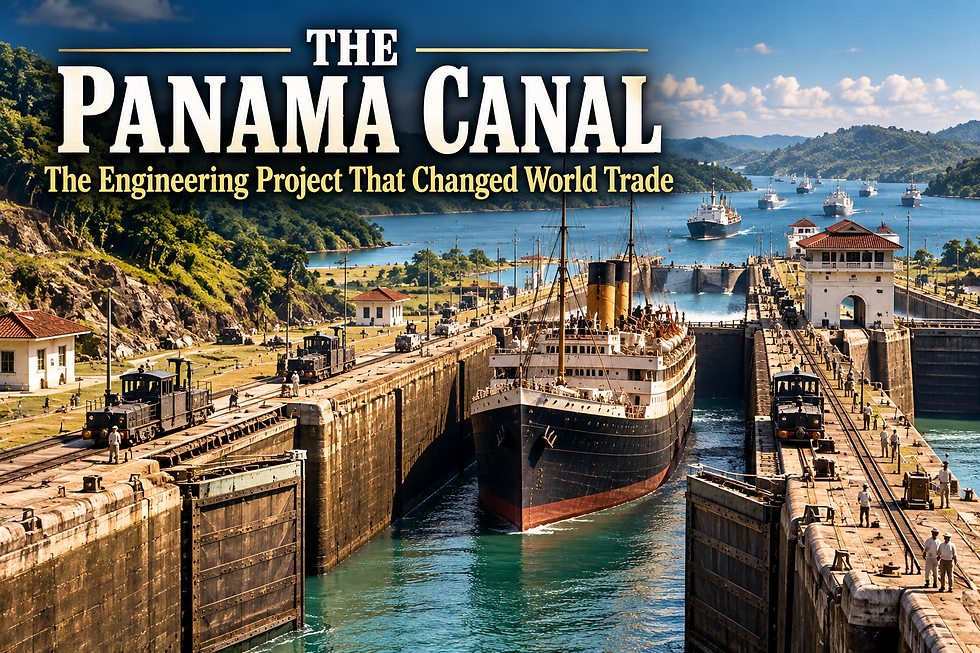
For centuries, ships traveling between the Atlantic and Pacific Oceans faced an enormous obstacle: the Americas.
A vessel sailing from the East Coast of the United States to the West Coast often had to travel thousands of extra miles around the southern tip of South America. The Panama Canal changed that.
When it opened in 1914, the approximately 50-mile waterway created a shortcut across the Isthmus of Panama and transformed international shipping.
The Dream of Connecting Two Oceans
The idea of building a canal across Central America existed long before construction began.
In the late 1800s, a French company led by Ferdinand de Lesseps, who had helped develop the Suez Canal, attempted to build a sea-level canal across Panama.
The project ended in failure.
Workers faced relentless rain, landslides, difficult terrain, and deadly diseases, particularly yellow fever and malaria. Thousands died, and the French effort eventually collapsed financially.
The United States Takes Over
The United States became increasingly interested in a Central American canal as its naval and commercial influence expanded.
After Panama declared independence from Colombia in 1903, the United States and Panama signed a treaty giving America control of the Canal Zone.
The United States purchased the remaining French equipment and property and began its own construction effort in 1904.
Instead of attempting a sea-level canal, American engineers developed a lock-based system that would lift ships above sea level and lower them again on the other side.
Overcoming Enormous Challenges

Building the canal required far more than digging a trench.
Workers excavated huge quantities of earth through the Culebra Cut, constructed massive locks, and created Gatun Lake by damming the Chagres River.
Disease was another major obstacle. Under the leadership of Dr. William Gorgas, sanitation teams worked to reduce mosquito populations and improve living conditions. These efforts dramatically reduced yellow fever and malaria among workers.
Tens of thousands of laborers participated in the project, including many workers recruited from Caribbean islands such as Barbados.
Changing the Movement of Ships

The Panama Canal officially opened on August 15, 1914.
Its lock system allowed vessels to enter chambers where water levels could be raised or lowered. Ships could then cross Gatun Lake before descending through another series of locks toward the opposite ocean.
The new route significantly reduced travel distances for many voyages.
Ships no longer needed to sail around Cape Horn when traveling between major ports on opposite sides of the Americas.
A Lasting Impact on World Trade

The canal quickly became one of the world's most strategically important waterways.
It helped goods, military vessels, raw materials, and passengers move between the Atlantic and Pacific more efficiently, strengthening trade connections between distant regions.
The United States controlled the canal for much of the twentieth century, but Panama assumed full control on December 31, 1999.
More than a century after its opening, the Panama Canal remains a vital link in global shipping.
Its construction demonstrated what modern engineering could accomplish, but it also came at tremendous human and political cost. The narrow waterway across Panama didn't simply connect two oceans. It permanently changed how the world moved.
Comments