
Pearl Harbor: The Attack That Brought America Into World War II


On the morning of December 7, 1941, Americans in Hawaii awoke to a devastating surprise attack.
Japanese aircraft descended on the U.S. naval base at Pearl Harbor, destroying ships, damaging aircraft, and killing thousands of Americans. The attack lasted only a few hours, but its consequences changed the course of American history.
The United States, which had remained officially outside World War II, was suddenly at war.
Tensions Between the United States and Japan
The attack did not happen without warning signs.
During the 1930s, Japan expanded aggressively across Asia, invading China and seeking greater control over territory and resources. The United States increasingly opposed Japanese expansion.
Washington responded with economic pressure, including restrictions on important materials and, eventually, an oil embargo.
Negotiations continued during 1941, but neither side was willing to accept the other's major demands.
Meanwhile, Japan secretly prepared for war.
Japan Plans a Surprise Attack
Japanese military leaders believed the U.S. Pacific Fleet represented a major obstacle to their plans in Southeast Asia and the Pacific.
Their solution was a surprise strike against Pearl Harbor.
A Japanese carrier force crossed the Pacific while maintaining secrecy. Early on December 7, hundreds of aircraft launched in waves toward the Hawaiian island of Oahu.
Many American servicemen were enjoying an ordinary Sunday morning when the attack began.
Pearl Harbor Comes Under Attack
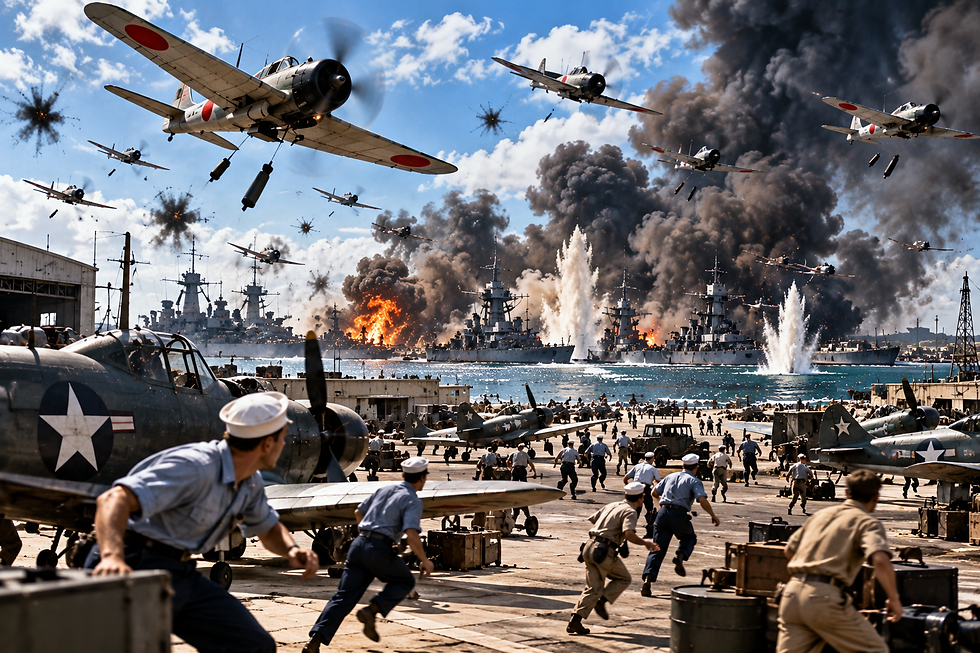
Shortly before 8 a.m., Japanese aircraft struck military targets across Oahu.
Pearl Harbor's Battleship Row became a primary target. Bombs and torpedoes hit several American battleships, including the USS Arizona, which exploded and sank.
Japanese aircraft also attacked nearby airfields, destroying or damaging many American planes before they could respond.
By the time the attack ended, more than 2,400 Americans had been killed. Numerous ships were sunk or damaged, and hundreds of aircraft were destroyed or damaged.
Japan had achieved tactical surprise, but several important American assets survived. The Pacific Fleet's aircraft carriers were not at Pearl Harbor during the attack.
Roosevelt Addresses Congress

News of Pearl Harbor spread quickly across the United States.
The following day, President Franklin D. Roosevelt addressed a joint session of Congress. He described December 7 as "a date which will live in infamy" and requested a declaration of war against Japan.
Congress overwhelmingly approved it.
Germany and Italy declared war on the United States several days later, and America responded by declaring war on them.
The United States was now fully involved in World War II.
An Attack That Changed America

Pearl Harbor transformed American public opinion almost overnight.
Debates about whether the United States should enter the war largely disappeared as the country mobilized its military, industries, and population for a global conflict.
Millions of Americans would serve in uniform, while factories at home shifted toward wartime production.
The attack also had darker domestic consequences, including the forced incarceration of Japanese Americans under Executive Order 9066 in 1942.
Pearl Harbor was intended to weaken America's ability to interfere with Japanese expansion. Instead, it brought the United States directly into World War II and began a military struggle that would reshape both the nation and the world.
Comments