
Simple Balance Exercises to Help You Stay Steady as You Age


Staying steady on your feet can make everyday activities feel easier and help you remain confident and independent as you get older. Balance can change with age for several reasons, including changes in muscle strength, vision, reflexes, and certain health conditions.
The encouraging part is that balance can be practiced. The National Institute on Aging recommends balance activities for older adults and suggests aiming for about three balance-exercise sessions each week.
Here are several simple exercises you can work into your routine.
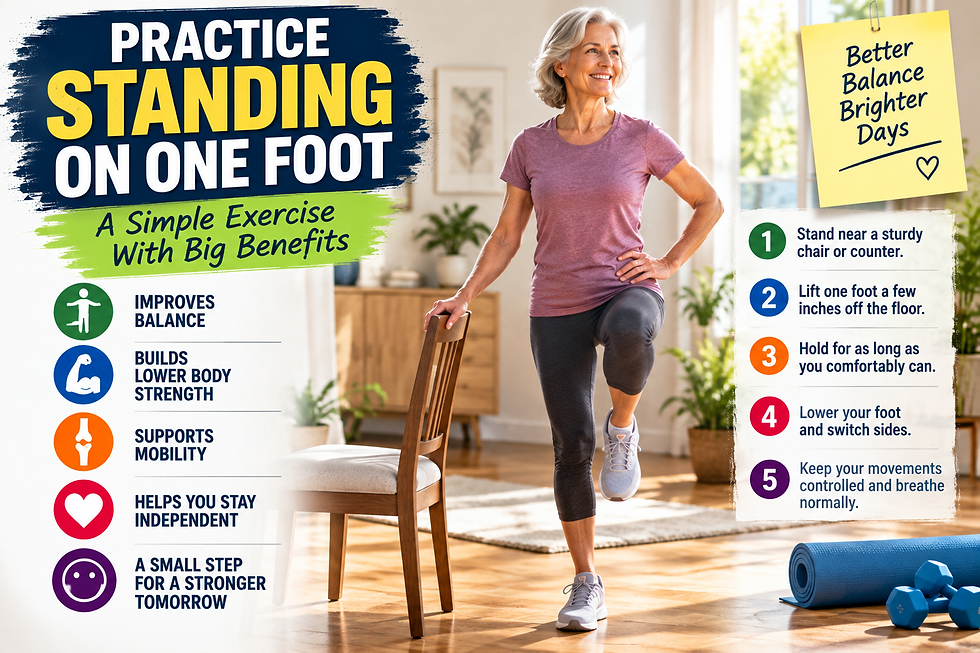
Practice Standing on One Foot
Start beside a sturdy chair or counter that you can hold if necessary.
Stand tall and slowly lift one foot a few inches from the floor. Hold the position for as long as you comfortably can, then lower your foot and switch sides. Keep your movements controlled rather than trying to hold the position for as long as possible.
Standing on one foot is one of the balance activities recommended by the National Institute on Aging.
Try a Heel-to-Toe Walk
Imagine you are walking along a straight line.
Place one foot directly in front of the other so that the heel of your front foot is close to the toes of your back foot. Continue forward slowly, taking controlled steps.
The heel-to-toe walk challenges you to maintain stability with a narrower base of support. It is included among balance activities recommended by both the National Institute on Aging and CDC.

Stand Up From a Chair
A chair can become a simple piece of exercise equipment.
Sit toward the front of a sturdy chair with your feet planted on the floor. Stand up carefully, pause, and then slowly sit back down. Use your hands for support if you need them.
Practicing the movement from sitting to standing is another activity the National Institute on Aging identifies as a balance exercise.
It also resembles something you do throughout everyday life, whether you are getting up from the dining table or leaving your favorite chair.

Add Sideways or Backward Walking
You do not always have to move forward to challenge your balance.
The National Institute on Aging includes walking sideways and backward among examples of balance activities.
Try these movements slowly in a clear, uncluttered area. Keep a wall, counter, or sturdy support nearby, especially when you are beginning.
Consider Tai Chi or Yoga
Balance training does not have to feel like a traditional workout.
Tai chi combines slow, controlled movements with deliberate shifts in body position, while yoga can incorporate balance, strength, and flexibility. Both are among the activities the National Institute on Aging identifies as options for balance exercise.
A beginner-friendly class can also provide guidance if you are uncomfortable practicing unfamiliar movements by yourself.
Make Safety Part of Every Exercise
Balance practice should challenge you without making you feel unsafe.
Keep a sturdy chair, wall, or another reliable support within reach. Move slowly, wear stable footwear, and stop if you feel unsteady. The National Institute on Aging advises seeking guidance from a doctor or physical therapist when you are unsure whether a particular movement is appropriate.
Persistent dizziness or balance problems can also have medical causes, so they should not automatically be treated as a normal part of aging.
Balance exercises do not need to be complicated. A few simple movements practiced regularly can become one part of an active lifestyle that supports stability, mobility, and independence as you age.
Comments