
THE FOUNDING FATHERS: THE VISIONARIES WHO BUILT A NATION

Updated: Sep 2
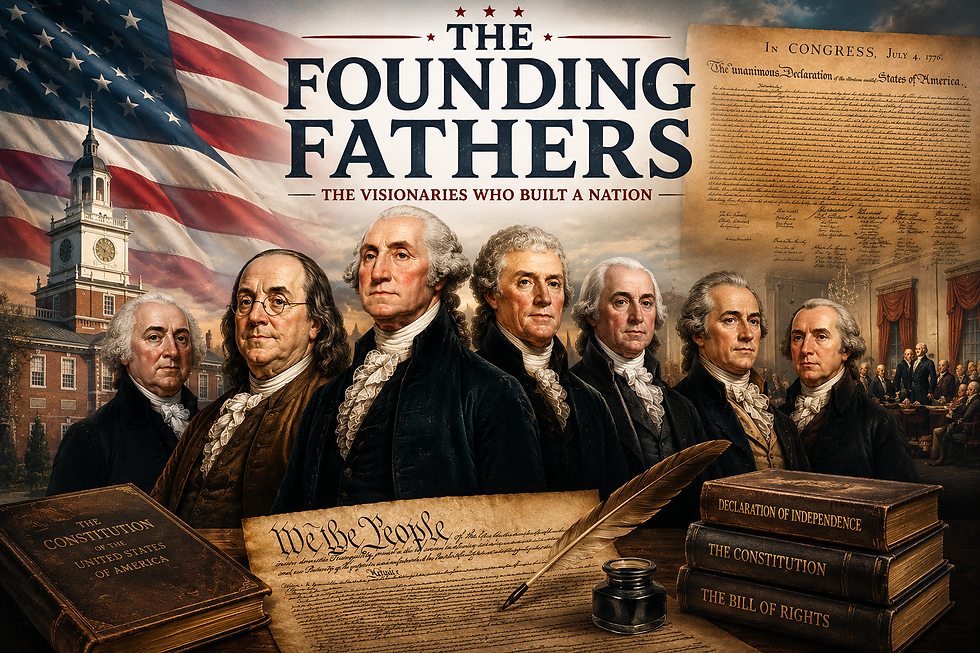
The story of America cannot be told without honoring the remarkable men known as the Founding Fathers. They were farmers, lawyers, merchants, soldiers, ministers, inventors, diplomats, and statesmen who risked their lives, fortunes, and sacred honor to create a nation founded on the revolutionary idea that individual liberty comes from God—not from government.
More than 250 years later, their vision continues to influence not only the United States but democracies around the world.
WHO WERE THE FOUNDING FATHERS?
The term "Founding Fathers" refers to the leaders who guided the American colonies through the struggle for independence and established the framework of the United States government.
While dozens of influential patriots contributed, several names stand above the rest:
George Washington – Commander of the Continental Army and America's first president.
Thomas Jefferson – Author of the Declaration of Independence and America's third president.
John Adams – Tireless advocate for independence and key diplomat.
Benjamin Franklin – Scientist, inventor, publisher, and one of America's greatest diplomats.
James Madison – Often called the "Father of the Constitution."
Alexander Hamilton – Architect of America's financial system.
John Jay – First Chief Justice of the United States.
Together, these men, along with many other patriots, helped shape a nation unlike any the world had ever seen.
A REVOLUTION UNLIKE ANY OTHER
By the 1770s, the American colonies had grown frustrated with British rule. They believed they were being taxed without representation and denied many of the rights enjoyed by English citizens.
Rather than simply demanding lower taxes, they argued for something far more profound:
That governments exist to protect the God-given rights of the people—not to grant them.
This belief became the cornerstone of American liberty.
On July 4, 1776, the colonies adopted the United States Declaration of Independence, declaring that:
"All men are created equal... endowed by their Creator with certain unalienable Rights..."
Those words forever changed history.
FAITH AND FREEDOM
Although the Founding Fathers held different personal religious beliefs, most agreed that morality, faith, and virtue were essential for a free society.
They understood that no government could remain free if its people lacked personal responsibility and moral character.
Many believed that freedom depended not only on good laws but also on citizens guided by faith, integrity, and self-government.
This principle remains one of America's greatest challenges—and greatest strengths.
THE CONSTITUTION: A BLUEPRINT FOR LIBERTY
After winning independence, the Founding Fathers faced another enormous challenge: creating a government powerful enough to function but limited enough to protect liberty.
The result was the United States Constitutional Convention and ultimately the United States Constitution.
Instead of concentrating power in one ruler, they created:
Three separate branches of government
Checks and balances
Federalism
Regular elections
Protection of individual rights
Soon afterwards came the United States Bill of Rights, guaranteeing freedoms such as speech, religion, the press, and the right to bear arms.
These safeguards were designed to limit government—not the people.
IMPERFECT MEN, ENDURING IDEAS
The Founding Fathers were not perfect.
Like every generation, they had flaws, disagreements, and shortcomings. Some held views and participated in practices that conflict with the principles we value today.
Recognizing those imperfections does not erase their extraordinary accomplishments.
Instead, it reminds us that history is complex. Their enduring contribution was creating a constitutional system capable of reform, self-correction, and peaceful change over time.
Understanding both their achievements and their failures gives us a fuller picture of America's founding.
LESSONS WE CAN STILL LEARN
The Founding Fathers understood that freedom requires effort.
They believed citizens should:
Stay informed.
Participate in government.
Protect individual liberty.
Respect the Constitution.
Defend the rights of future generations.
Live with integrity and personal responsibility.
Those lessons remain just as relevant today as they were in 1776.
WHY THEIR LEGACY STILL MATTERS
America's founders built more than a government—they established principles that continue to inspire people around the world.
The ideas of liberty, limited government, personal responsibility, and equal opportunity remain central to the American experiment.
Whether discussing politics, history, education, or civic life, understanding the Founding Fathers helps us better appreciate both the freedoms we enjoy and the responsibilities that come with them.
Their work reminds us that freedom is never automatic. Every generation has the opportunity—and the responsibility—to preserve it.
FINAL THOUGHTS
The Founding Fathers left behind more than historic documents. They left a vision of a nation where liberty would flourish under the rule of law, where power would be limited, and where citizens—not kings—would shape the future.
America's story continues to be written, but its foundation remains rooted in the courage, sacrifice, and enduring principles established by those who dared to dream of a free nation.
"Freedom is not merely inherited—it is preserved by every generation willing to defend it."
— Chris Triana
Comments