
What Your Dog’s Body Language Is Trying to Tell You


Dogs communicate with us constantly, even though they cannot use words. Their ears, eyes, mouth, tail, posture, and movements can all provide clues about how they are feeling in a particular moment.
Learning to notice these signals can help you understand when your dog feels relaxed, excited, uncertain, or uncomfortable. The key is to look at the whole dog and consider what is happening around them rather than relying on one signal alone.
A Relaxed Body Usually Signals Comfort
A comfortable dog generally has loose, natural-looking body language. Their muscles may appear relaxed, their mouth may be slightly open, and their movements are typically easy rather than stiff.
You might also notice your dog resting comfortably or approaching people without hesitation. These signals can suggest that they feel safe in their current environment.

Tail Movement Is More Than Wagging
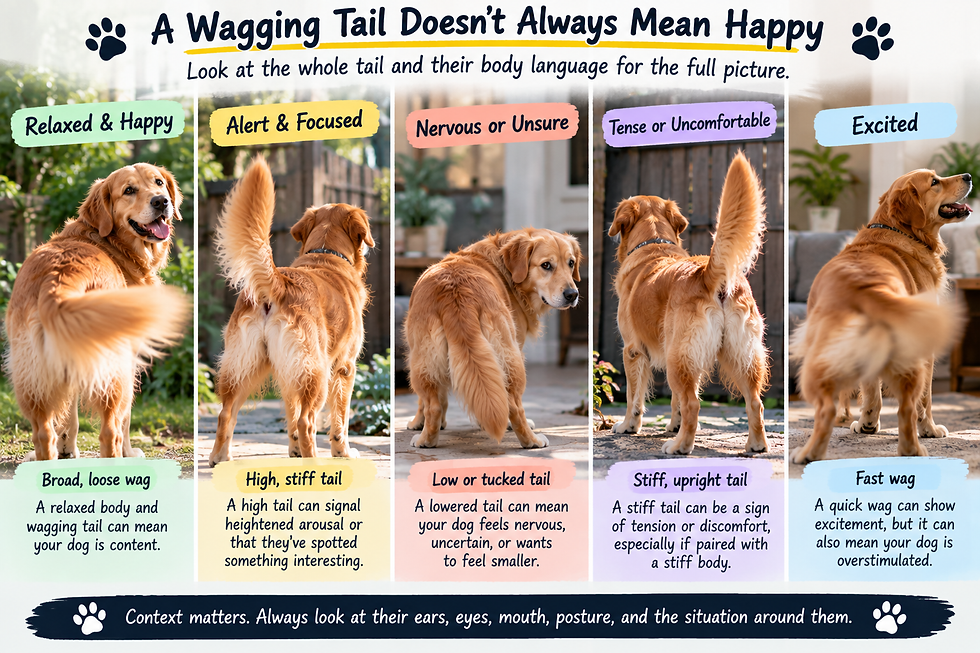
A wagging tail does not automatically mean a dog is happy. The position, speed, and overall movement of the tail can provide additional context.
A broad, loose wag accompanied by relaxed body language can appear during friendly interactions. A high, stiff tail or very tense wag may indicate heightened arousal. A lowered or tucked tail can sometimes appear when a dog feels nervous or uncertain.
Pay Attention to Their Ears and Eyes
Ear position can change depending on what has captured your dog's attention. Ears held naturally may accompany relaxation, while ears pushed back can appear during uncertainty, fear, excitement, or social interaction.
Eyes can provide clues too. Soft eyes generally look different from a hard, fixed stare. Some dogs may also show more of the whites of their eyes when they are uncomfortable. Always consider these signals alongside the rest of the dog's posture.
Their Mouth Can Reveal Important Clues
A relaxed dog may have a loose mouth or slightly open jaw. When tension increases, the mouth can suddenly close, or the lips and facial muscles may appear tighter.
Lip licking and yawning can sometimes occur when a dog feels uncertain or stressed, although dogs also perform these behaviors for ordinary reasons. Context helps determine what a particular behavior might mean.
Posture Can Show Confidence or Discomfort
A dog's entire body can communicate useful information. A comfortable dog may stand naturally with balanced weight and relaxed muscles.
A nervous dog might lower their body, lean away, freeze, or attempt to create distance. A stiff posture can signal that the dog is highly alert or uncomfortable. Giving the dog space may be appropriate when several signs of tension appear together.
Play Has Its Own Body Language
Dogs often use exaggerated movements during play. A play bow, where the front of the body lowers while the rear stays raised, is one familiar example.
Bouncy movements, loose bodies, and taking turns during play can also indicate a comfortable interaction. If one dog repeatedly tries to escape, hides, or becomes stiff, however, it may be time to interrupt the activity.

Watch for Changes From Normal Behavior
Every dog communicates a little differently. Breed, age, physical characteristics, previous experiences, and personality can affect how their signals appear.
Learning your own dog's normal behavior gives you a useful baseline. A sudden change in posture, activity, social behavior, or tolerance for touch may deserve attention, particularly if it persists or appears alongside signs of pain or illness.
Final Thoughts
Understanding dog body language is less about memorizing individual signals and more about observing patterns. Look at the ears, eyes, mouth, tail, posture, movement, and surrounding situation together.
The better you understand your dog's communication, the easier it becomes to respect their boundaries and respond appropriately. Paying attention to those quiet signals can support safer interactions and a stronger relationship.
Comments