
The Whiskey Rebellion: America’s First Test of Federal Power


Only a few years after the Constitution took effect, the United States faced a major question: Could the new federal government actually enforce the laws it passed?
The answer came during the Whiskey Rebellion, a conflict that began over a federal tax on distilled spirits and escalated into violent resistance in western Pennsylvania. By 1794, President George Washington faced one of the first serious challenges to federal authority under the Constitution.
Why did the government tax whiskey?
The United States emerged from the Revolutionary War carrying substantial debt. Treasury Secretary Alexander Hamilton supported policies designed to strengthen federal finances, including an excise tax on distilled spirits. Congress enacted the tax in 1791.
The tax was especially unpopular among many western farmers. Grain could be difficult and expensive to transport over poor roads, so farmers often distilled crops such as rye and corn into whiskey, which was easier to store and transport. Many small producers believed the tax placed an unfair burden on their livelihoods.
Resistance soon spread. Some people refused to pay, while tax collectors and those who cooperated with federal officials faced intimidation and violence.

Resistance turns into rebellion
By 1794, the dispute had become much more serious.
In July, hundreds of armed protesters confronted federal revenue supervisor John Neville near Pittsburgh. His property was attacked, and his house was eventually burned. Opposition to the whiskey tax had developed into an organized challenge to federal law.
Washington initially pursued peaceful solutions. Commissioners were sent to western Pennsylvania to negotiate, and the administration offered leniency in exchange for compliance. When those efforts failed to fully restore order, Washington prepared a military response.

Washington calls out the militia
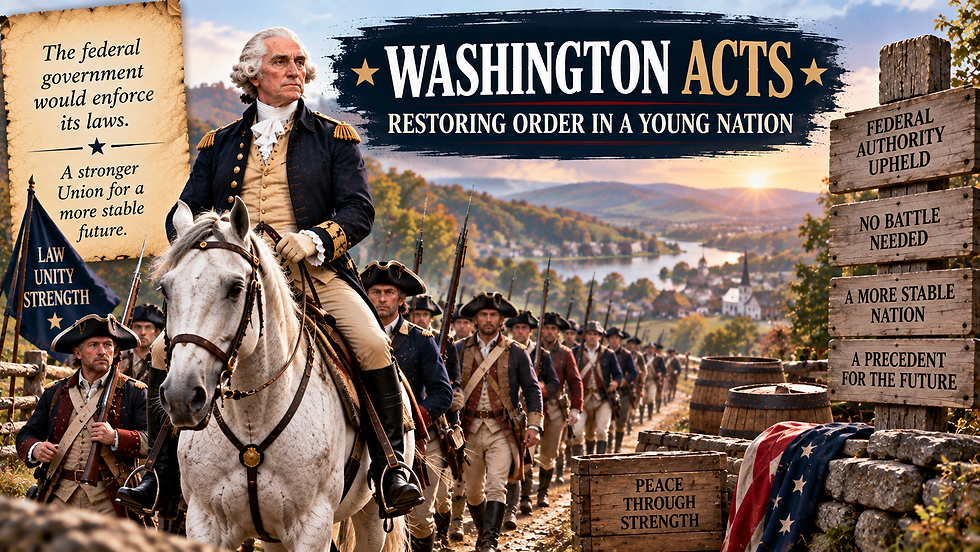
Using authority provided under federal law, Washington called militia forces from Pennsylvania, Virginia, Maryland, and New Jersey. Nearly 13,000 troops were assembled, creating a force larger than the army Washington had commanded during much of the Revolutionary War.
Washington personally accompanied the troops as far west as Bedford, Pennsylvania, before leaving the remaining operation to other commanders.
The overwhelming show of force meant that there was no major battle. By the time the militia moved farther into western Pennsylvania, organized resistance had largely collapsed and many of its leaders had fled.
What happened to the rebels?
Federal authorities arrested participants and brought some of them to trial. Two men were ultimately convicted of treason in federal court, but Washington later pardoned both.
The whiskey tax itself survived the rebellion. It remained in place until it was repealed during Thomas Jefferson’s presidency in 1802.
Why the Whiskey Rebellion mattered
The rebellion became an important early test of the government created by the Constitution. Under the Articles of Confederation, the national government had struggled to enforce its decisions. The events of 1794 demonstrated that the new federal government possessed greater authority and could mobilize resources to enforce federal law.
The episode also exposed an enduring tension in American politics. Citizens could oppose government policies, but the new constitutional system gave the federal government mechanisms for enforcing laws enacted through its political institutions.
The Whiskey Rebellion ended without a large-scale military confrontation, but its significance went far beyond a tax on distilled spirits. It helped establish an early precedent that the federal government could enforce its laws even when organized resistance challenged its authority.
Comments