
Why Civil Disagreement Is Essential in a Free Society


A free society does not require everyone to agree. In fact, disagreement is an unavoidable part of living in a country where people are free to form opinions, express ideas, organize around causes, and participate in government.
The American constitutional system recognizes that people will hold different political, religious, economic, and social views. The challenge is not eliminating those differences. It is creating ways for people to express and resolve them without abandoning the rights of others or the rules that allow a free society to function.
Freedom Makes Disagreement Possible
The First Amendment protects freedoms of speech, religion, press, peaceful assembly, and petition. Together, these protections provide constitutional space for people to express different ideas and advocate for change. Historical records show Americans using speech, assembly, and petitions to participate in public debates for generations.
Those freedoms matter most when people disagree.
Protecting speech only when an idea is popular would provide little protection at all. A society committed to freedom must leave room for competing viewpoints, including criticism of government and established ideas.
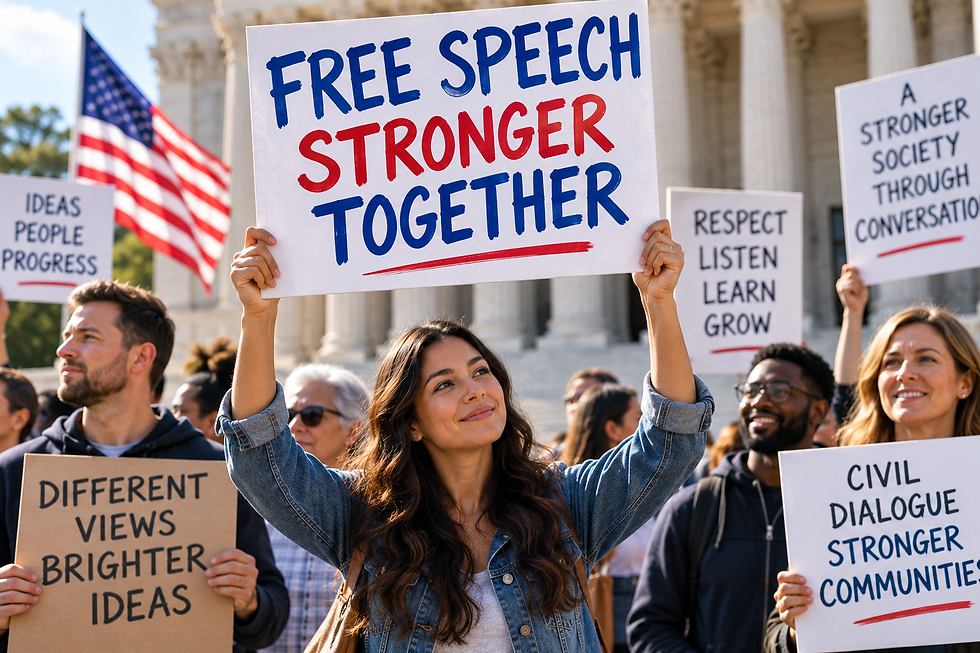
The Founders Expected Different Opinions
Political disagreement is not new to the United States.
The debate over ratification of the Constitution itself produced sharp divisions. Federalists supported the proposed Constitution, while opponents raised concerns about the structure and powers of the new federal government. Those disagreements contributed to demands for protections that ultimately became the Bill of Rights.
James Madison also addressed disagreement in Federalist No. 10. He argued that different opinions and interests naturally arise when people are free. Rather than trying to eliminate those differences by eliminating liberty, Madison focused on designing a political system capable of managing their effects.

Civil Disagreement Is Different From Hostility
Disagreement does not require treating another person as an enemy.
Civil disagreement means people can strongly challenge an argument while recognizing that others retain the same basic rights to speak, organize, vote, petition, and participate.
That distinction is important because political conflict can become personal very quickly. Listening carefully does not require accepting another person's conclusion. Likewise, respecting someone's right to express an opinion does not mean agreeing with that opinion.
Civility allows disagreement to remain focused on ideas, evidence, policies, and decisions.

Debate Can Expose Weaknesses in Ideas
Disagreement can also improve public discussion.
When an argument faces questions and criticism, its assumptions may become easier to identify. People may encounter evidence they had not considered or discover consequences that were overlooked.
The result will not always be agreement.
Sometimes discussion strengthens opposing positions rather than resolving them. But a free society provides processes for continuing those disagreements through elections, legislatures, courts, petitions, public advocacy, and other lawful forms of participation.
American political parties themselves developed partly from conflicts over the Constitution and the direction of the new federal government.
Freedom Includes Living With Differences
Civil disagreement can be difficult because important issues often involve deeply held beliefs.
Still, freedom does not depend on citizens reaching the same conclusion about every issue. It depends in part on maintaining institutions and rights that allow disagreements to continue without denying others their opportunity to participate.
That makes civil disagreement more than good manners.
It is one way citizens practice freedom itself: expressing different views, challenging ideas, listening to opposing arguments, and continuing to share a society even when consensus remains out of reach.
Comments