
Why Religious Freedom Matters in America


Religious freedom has been part of the American constitutional system since the nation's earliest years, but the principle is broader than the freedom to attend a particular church. It protects people's ability to hold religious beliefs, practice their faith within the law, change their beliefs, or choose not to follow a religion.
The United States did not begin with complete agreement about how religion and government should interact. Some colonies and early states supported particular churches, while religious minorities often pushed for greater protection of individual conscience. Those debates eventually helped shape the protections Americans recognize today.
Protecting the freedom of conscience
One important step came in Virginia. Thomas Jefferson drafted a bill for religious freedom in 1777, and the Virginia General Assembly adopted it in 1786 with support from James Madison. The law rejected government coercion in matters of religious worship and protected people from civil penalties because of their religious opinions.
The idea was significant because it treated religious belief as a matter of individual conscience rather than something government should dictate.
Madison also argued for stronger religious-liberty protections. When he later helped advance the Bill of Rights, religious freedom became part of the First Amendment.

What does the First Amendment protect?
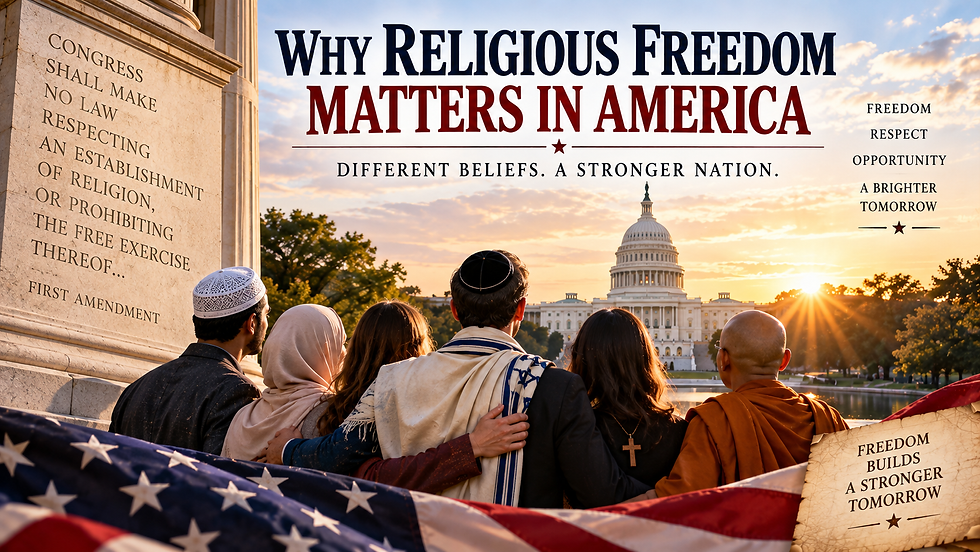
The First Amendment addresses religion through two provisions. It prohibits government establishment of religion and protects the free exercise of religion. These protections were ratified as part of the Bill of Rights in 1791.
Together, these principles create protections against government favoring an official religion while also safeguarding religious exercise. The Constitution contains another important protection in Article VI, which prohibits religious tests as qualifications for federal office.
Religious freedom therefore applies across different beliefs. Its protections are important not only for members of large religious traditions but also for smaller faith communities and people who do not practice a religion.

Making room for different beliefs
The United States has always contained people with different religious convictions. Religious freedom provides a legal framework in which those differences can exist without requiring everyone to share the same beliefs.
That does not mean every dispute involving religion has a simple answer. Questions about religious exercise, government institutions, education, employment, and other areas have produced continuing legal debates. The Constitution's religion clauses have consequently been interpreted through laws and court decisions over generations.
The underlying principle, however, remains that government power over matters of belief is constitutionally limited.
Religious freedom protects everyone
Religious liberty can sometimes be discussed mainly in terms of protecting religious people. But freedom of conscience works in more than one direction.
A government powerful enough to impose one religious belief could also restrict another. Protections against government establishment and for religious exercise help create space for individuals to reach their own conclusions about faith.
This principle developed gradually. Even after the First Amendment was adopted, some states maintained forms of government-supported religion into the nineteenth century. American religious liberty was therefore not created in a single moment but developed through political debate, legislation, constitutional protections, and court decisions.
Religious freedom matters in America because it protects a deeply personal area of individual life from unnecessary government control. In a country containing many faiths and viewpoints, it allows people with profound disagreements about religion to live under the same constitutional system while retaining the freedom to follow their own conscience.
Comments