
Why Small Dogs Often Think They’re Ten Feet Tall


A Chihuahua spots a German Shepherd across the sidewalk.
The Chihuahua weighs eight pounds. The German Shepherd may weigh ten times that much. Yet somehow, the little dog is the one barking as if he's ready to defend the entire neighborhood.
If you've ever lived with a small dog, you've probably seen some version of this confidence.
Small dogs can seem remarkably bold around larger animals, unfamiliar people, and anything else they consider suspicious. It may look like they have absolutely no idea how small they are.
The explanation is a little more complicated.
Small Dogs Are Still Dogs
It's easy for people to think of tiny dogs as fundamentally different from larger breeds.
But size doesn't erase normal canine instincts.
Small dogs still protect resources, investigate unfamiliar sounds, defend territory, chase things, communicate with other dogs, and react when something makes them uncomfortable.
A six-pound dog can feel just as strongly about a stranger approaching the front door as a 70-pound dog does.
The difference is that the reaction can look surprisingly dramatic coming from such a small body.
Barking Can Make Something Back Away
Imagine being much smaller than nearly everything around you.
You can't rely on physical size to make yourself intimidating.
Noise, however, is available.
Barking, growling, lunging, or putting on an impressive display can create distance between a small dog and something that worries him.
Sometimes it works.
The delivery driver leaves. The unfamiliar dog continues down the sidewalk. The stranger walks past the house.
From the dog's perspective, making a huge fuss may appear to have solved the problem.
That can make the behavior more likely to happen again.

We Treat Small Dogs Differently
People often respond differently to behavior from small dogs.
If a large dog jumps, lunges, or barks aggressively at someone, the owner will probably take the behavior seriously.
When a tiny dog does the same thing, people may laugh, pick him up, or describe him as feisty.
Small dogs are also easier to physically manage. You can scoop up a Chihuahua and carry him away from a situation. Doing the same thing with a Great Dane isn't an option for most people.
Because of this, little dogs sometimes get fewer opportunities to learn how to calmly handle situations on their own.
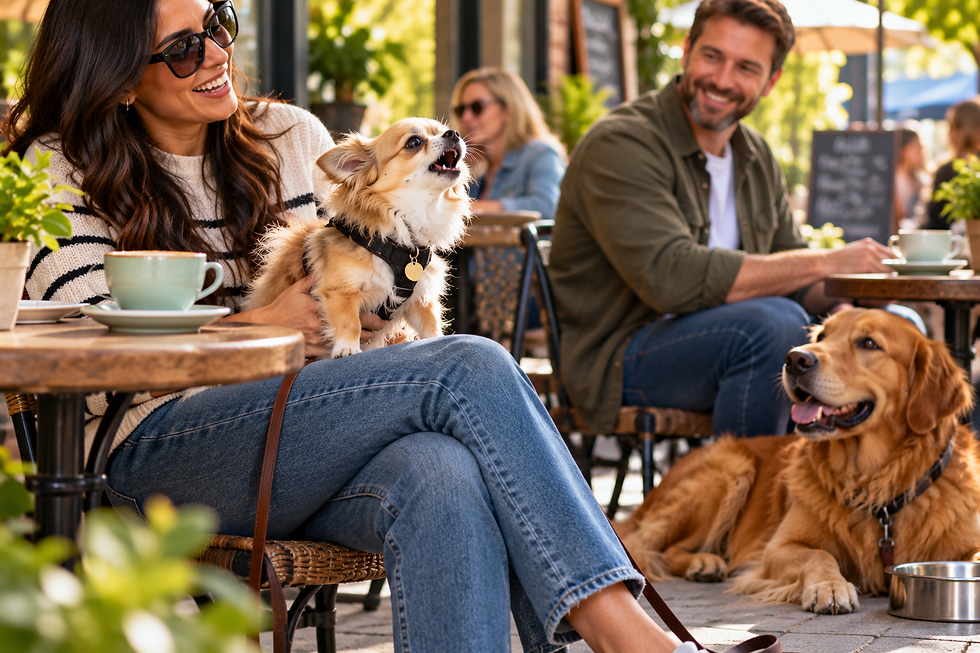
Being Picked Up Changes the View
For a small dog, suddenly being lifted several feet into the air can completely change an interaction.
Now he's looking down at the dog or person that worried him.
He's also safely attached to his favorite human.
Some dogs relax when they're picked up. Others continue barking from their new position, occasionally with even more enthusiasm.
That doesn't necessarily mean the dog suddenly feels powerful. He may still be excited, nervous, frustrated, or overwhelmed.
Confidence Depends on the Individual Dog
Not every small dog is fearless.
Some are cautious. Some hide behind their owners. Others happily greet every person and dog they encounter.
Breed tendencies, early experiences, socialization, training, environment, and individual personality can all influence behavior.
A bold little dog isn't necessarily trying to prove he's the toughest animal on the block.
He may be excited. He may be worried. He may have learned that barking works. Or he may simply be a naturally confident dog who happens to come in a very small package.
Either way, don't assume he doesn't notice the size difference.
He might know exactly how small he is.
He just has a lot to say about it.

Comments