
Why the Rule of Law Matters


The rule of law sounds like a legal concept reserved for judges, lawyers, and courtrooms. In reality, it affects ordinary life every day.
At its core, the rule of law means that people and institutions are accountable to established laws. That includes private citizens, businesses, government agencies, elected officials, and others who exercise public authority.
The principle helps create a system in which decisions are governed by law rather than simply by the wishes of whoever happens to hold power.
The Law Applies to Everyone

One of the most important ideas behind the rule of law is that government officials are subject to law too.
The federal judiciary describes the rule of law as a principle under which people, institutions, and entities are accountable to laws that are publicly established, equally enforced, and independently adjudicated.
This principle has deep roots in American government. John Adams famously described the ideal as “a government of laws, and not of men.” The idea was straightforward: public authority should operate according to established rules instead of the personal preferences of individual leaders.
Predictable Laws Make Everyday Life Possible

The rule of law matters outside government too.
People make decisions every day with the expectation that laws and legal agreements have meaning. They sign contracts, purchase homes, operate businesses, own property, and resolve disputes based partly on the assumption that established rules will be applied.
Federal courts have noted that clear and consistently applied laws contribute to safety, predictability, and stability.
Without that predictability, ordinary decisions become harder. Rules that constantly change, remain secret, or are enforced arbitrarily make it difficult for people to know what conduct is permitted or what protections they can expect.
The Constitution Limits Government Power
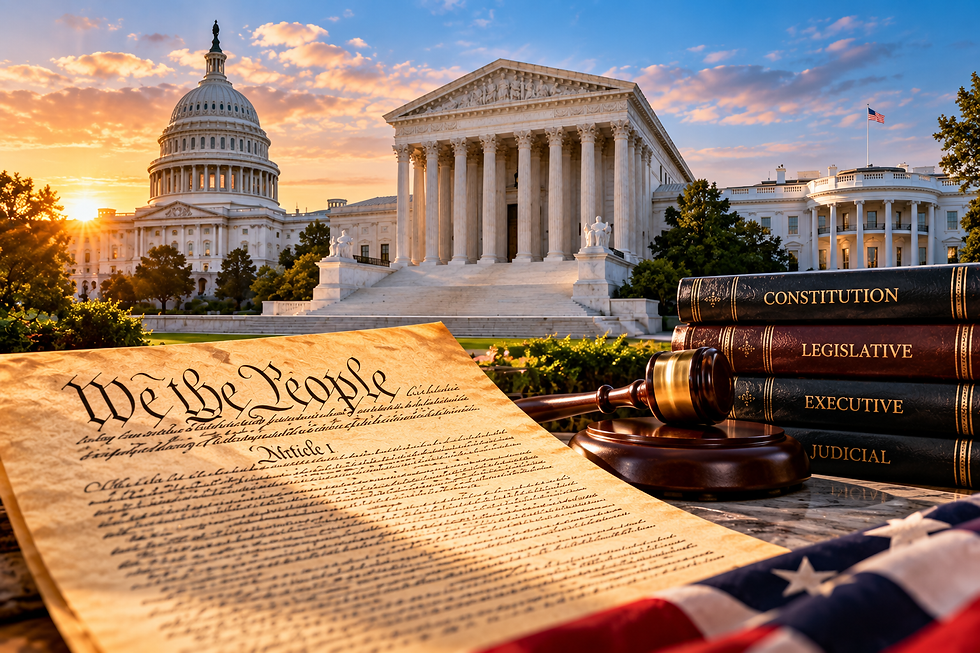
In the United States, the Constitution is the nation’s fundamental law. It establishes the structure and powers of the federal government while placing limits on how those powers may be exercised.
The Constitution divides federal authority among legislative, executive, and judicial branches. Courts have an important role because they interpret laws and resolve cases and controversies within their constitutional authority.
Alexander Hamilton argued in Federalist No. 78 that when an ordinary law conflicts with the Constitution, the Constitution must take priority.
This reflects a central feature of constitutional government: government power itself operates within a legal framework.
Rights Depend on Fair Legal Processes
Written rights matter, but protecting them also requires institutions and procedures capable of applying the law.
The American legal tradition includes protections such as due process, and the Bill of Rights protects freedoms including speech and religion. Courts can also hear disputes involving claims that government action has violated constitutional rights.
The ideal is not that every person will always agree with every law or court decision. Rather, disputes should be addressed through established legal processes instead of arbitrary power.
A Principle That Requires Constant Work
The rule of law does not guarantee that every law will be wise or that every legal decision will be correct. American history contains many examples of unjust laws and unequal treatment.
That distinction matters. Having laws is not enough by itself. The rule of law depends on how laws are created, enforced, interpreted, and applied.
The principle remains important because it establishes a standard: laws should be public, government authority should have legal limits, legal processes should be independent, and people should be accountable under the law.
Those expectations help turn written laws into a functioning system of government.
Comments